Bastiaannet, Malone Awarded Siteman Investment Program Cancer Research Grants
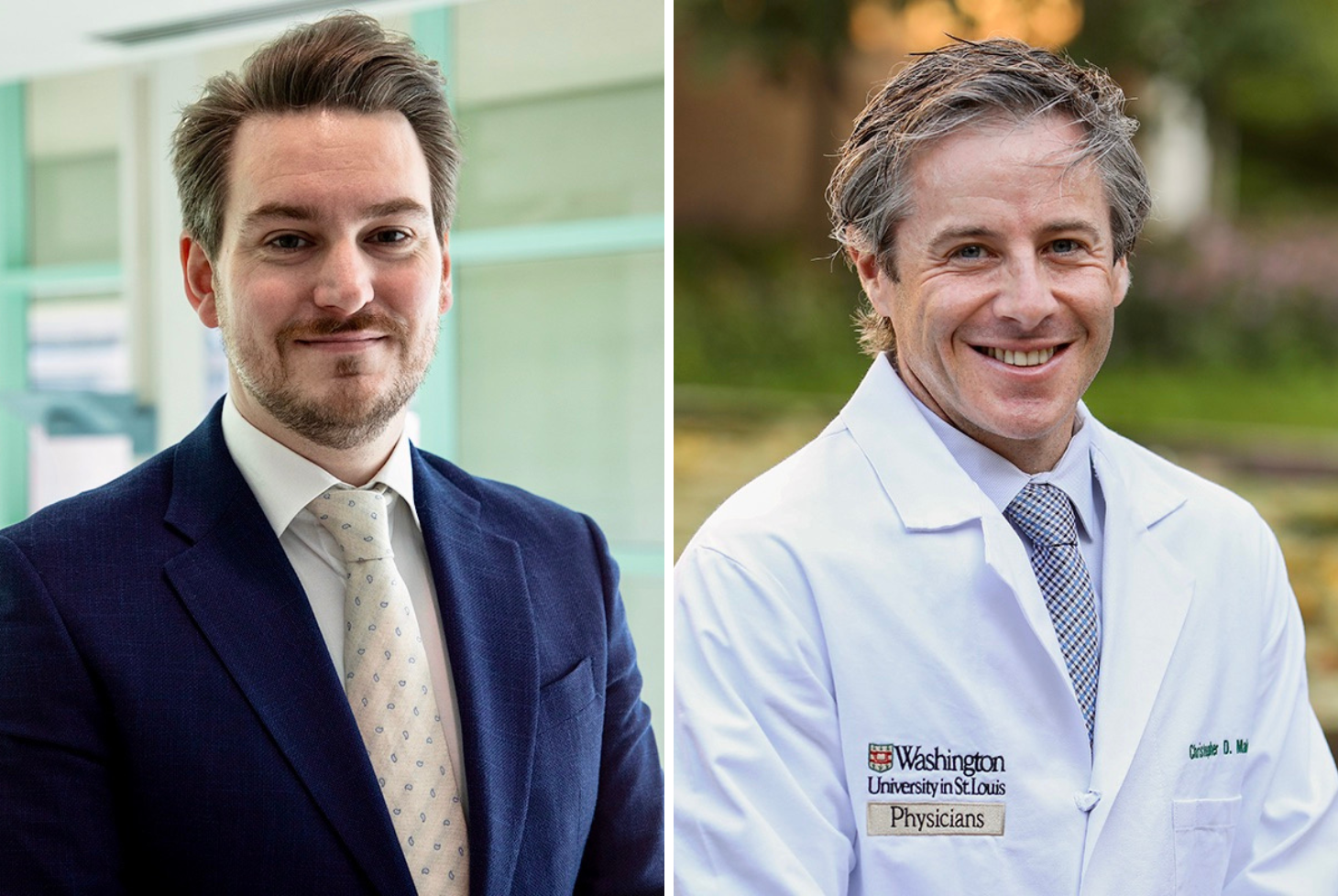
Two MIR investigators received a portion of $2.42 million in new grants announced by Siteman Cancer Center at Barnes-Jewish Hospital and WashU Medicine to fund their cancer research projects. Both researchers were selected for grants in the Pre-R01 Category, which awards up to $200,000 over two years.
Remco Bastiaannet, PhD, assistant professor of radiology and principal investigator in the Precision Radiotheranostics Translation Center (PRTC), aims to develop a safer and more effective radiotherapy treatment for patients with advanced colorectal cancer.
Colorectal cancer often spreads to the lining of the abdomen, forming small tumors that are hard to detect and treat. Bastiaannet and co-investigator David Bauer, PhD, an assistant professor of chemistry at University of Missouri, aim to leverage intraperitoneal targeted alpha therapy (IP TAT) — an approach that delivers powerful cancer-killing radiation known as alpha particles directly into the abdominal cavity, precisely targeting cancer cells while minimizing damage to healthy tissue. Their project is broken into two phases; the first will test specially designed radioactive drugs made to seek out and attach to colorectal cancer cells to find the one that most effectively reaches tumors and stays in place long enough to be effective, and the second will use advanced imaging techniques and computer modeling to precisely measure where the radiation accumulates and how much radiation the tumors receive.
Christopher D. Malone, MD, associate professor of radiology and principal investigator in the Biophotonics Research Center (BRC), aims to find biomarkers that predict which liver cancer patients will respond to Yttrium-90 radioembolization (Y-90-RE) and immune checkpoint inhibitors (ICIs). His project could help guide more personalized and effective treatment for early and intermediate-stage liver cancer.
Y-90-RE is an effective treatment for early-stage HCC, but many patients — especially those with more advanced disease — still see their cancer return, likely due to small groups of cancer cells that survive treatment by resisting therapy or avoiding the immune system. ICIs have shown promise in treating advanced HCC, but their use with Y-90-RE in earlier stages lacks molecular data to guide decisions. Malone aims to find molecular and immune features in tumors that predict which patients will respond to Y-90-RE alone and which may benefit from adding ICIs. Using a special collection of tumor samples from patients treated with Y-90-RE, with or without ICIs, Malone will study gene activity across different parts of the tumor using a spatial mapping technology called Xenium.
Read more from Siteman Cancer Center.