Eggebrecht Awarded $3.7M Grant to Study Motor Imitation in Autism
Adam T. Eggebrecht, PhD, associate professor of radiology at WashU Medicine Mallinckrodt Institute of Radiology (MIR) and principal investigator in the Biophotonics Research Center, received a $3.7 million grant from the National Institute of Mental Health (NIMH). The funding will support research on autism spectrum disorder in children, including whether imitation difficulties are more specific to autism and whether the underlying brain activity differs from that seen in other developmental conditions.
Autism spectrum disorder affects about 1 in 36 children in the United States. Diagnosis can be especially challenging when a child also has comorbidities such as attention-deficit/hyperactivity disorder (ADHD) or developmental language disorder, since overlapping symptoms may delay support. Because imitation plays a key role in early social and communication development — copying facial expressions, gestures and actions — researchers believe difficulties with motor imitation may be linked to core features of autism.
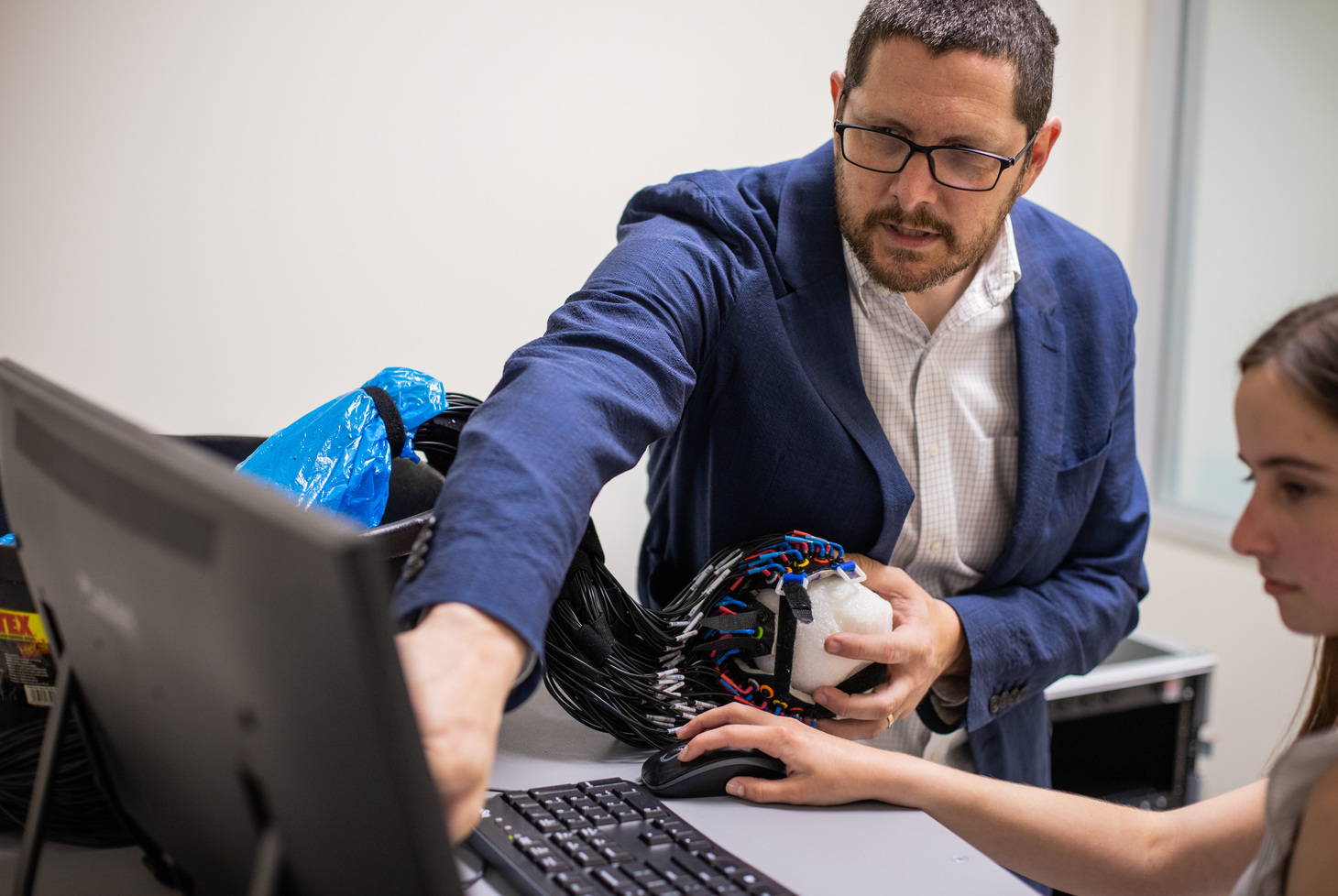
With the support of the grant, Eggebrecht and his team in the Brain Light Laboratory are studying a promising biomarker for autism by combining two technologies: a wearable brain-imaging cap using high-density diffuse optical tomography (HD-DOT) and a computerized movement imitation test known as the Computerized Assessment of Motor Imitation (CAMI). The team will study children ages 6 to 10 with autism, ADHD, developmental language disorder and neurotypical development to measure their imitation accuracy and brain activity during short, engaging tasks. The team will extend the work to children ages 3 to 5 to better understand how these patterns emerge early in development. A key part of the project will test whether CAMI works with both specialized 3D depth cameras and more widely available 2D cameras. If successful, this could make the method easier to use in clinics and at home. The team will also use machine learning to analyze movement patterns and develop a way to measure imitation from 2D video alone.