Supercharging Cancer Medication with Click Chemistry
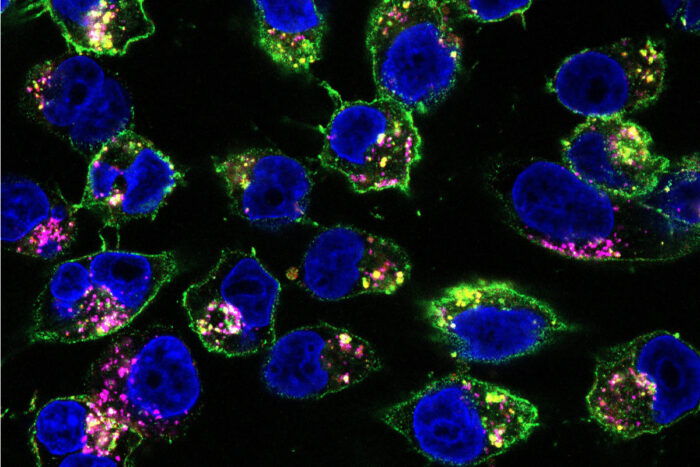
Image credit: Shayla Shmuel
In recent years, antibody-drug conjugates have been changing the cancer care landscape. For patients for whom standard chemotherapy has not worked, these precise treatments combine tumor-fighting drugs with proteins that specifically target cancer cells; however, they can only attack one type of target at a time, thus limiting their effectiveness against tumors containing multiple types of targets.

Patrícia M. Ribeiro Pereira, PhD, assistant professor of radiology at WashU Medicine Mallinckrodt Institute of Radiology and principal investigator in the Precision Radiotheranostics Translation Center, and colleagues have published a study in Nature showing the potential to increase the effectiveness of antibody-drug conjugates by leveraging click chemistry — a method that allows connector molecules to link with a range of other compounds, creating flexible, interchangeable molecular structures.
Ribeiro Pereira and her team in the Disease Imaging and Therapy Lab modified U.S. Food and Drug Administration-approved drugs so they could self-assemble inside the body and target more than one cancer marker at once. Tested in pancreatic, gastric and breast cancer tumor cells containing EGFR and HER2 receptor expression, the team combined three components in the medications, each with a specialized role: a cytotoxic drug, an antibody protein and a linking molecule. Because each drug can bind to only one antibody partner, these conjugates are highly specific and affect only cells with the right receptors, making them especially effective in relatively homogeneous tumors. The team found that mouse tumor cells absorbed larger amounts of the modified antibody-drug conjugates than the original versions. They believe this may be because click chemistry causes antibodies to cluster on the cancer cell surface, which helps the cells take them in more efficiently.
“We’ve shown that when two cancer-targeting antibodies bind together inside the body, they accumulate at the tumor more effectively and improve treatment response,” said Ribeiro Pereira in a press release. “There is a lot of excitement here because we have shown that it isn’t necessary to create a whole new drug platform for each therapeutic target. We can repurpose antibodies that already exist to improve treatments.”
Read more from WashU Medicine.