

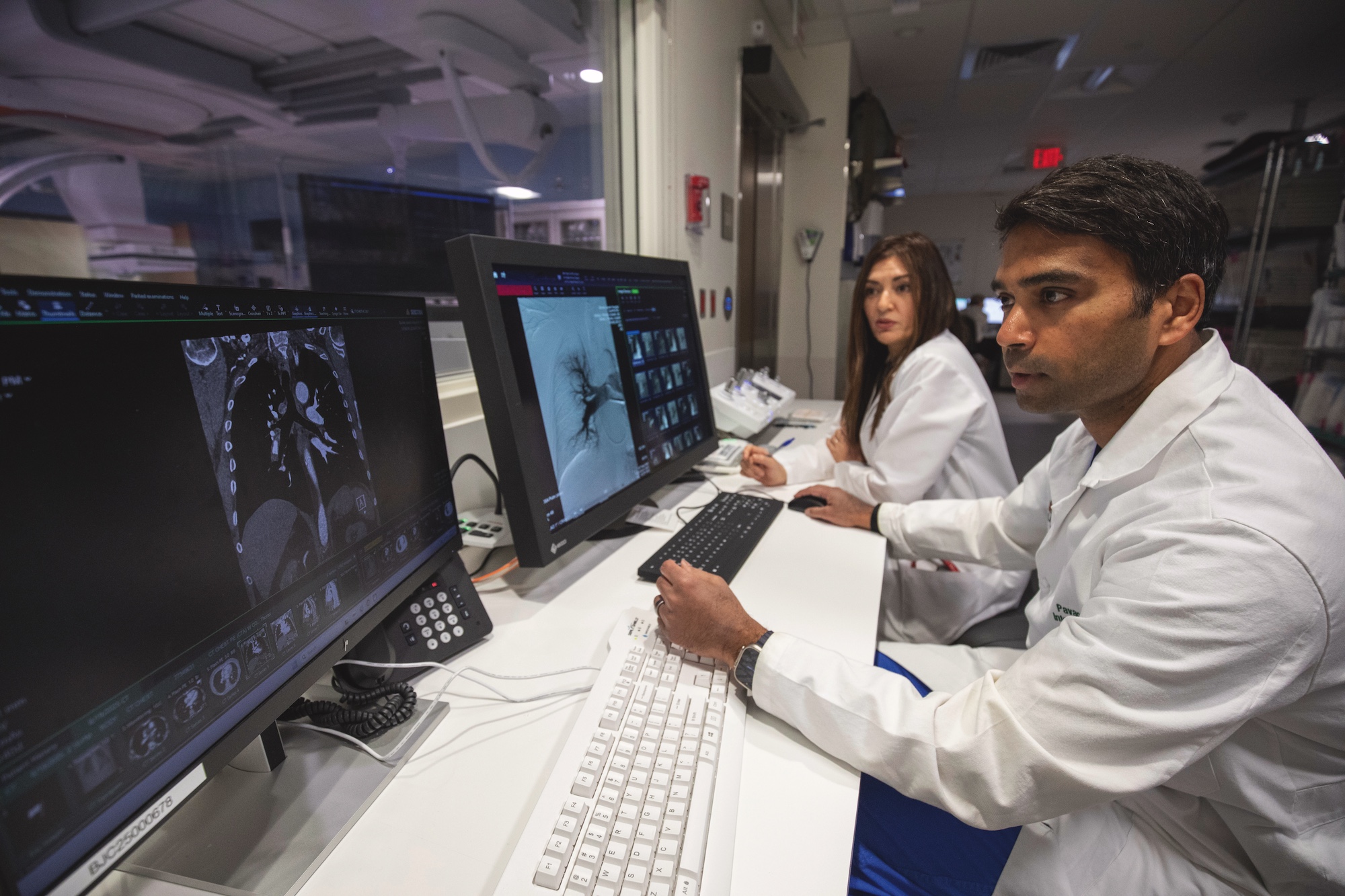
Treating acute pulmonary embolism (PE) is not only a race against time but a test of collaboration. Despite being the third-leading cause of cardiovascular mortality in the U.S., there is not enough evidence to indicate a single “right” treatment approach for these patients. And with high-risk PE sitting at the intersection of multiple specialties, it can leave care teams wondering whom to call.
“Just diagnosing PE can be difficult because it has nonspecific symptoms such as chest pain, shortness of breath and coughing, which mimic other heart and lung conditions,” said Pavan K. Kavali, MD, associate professor of radiology and associate director of interventional radiology (IR) at Barnes-Jewish West County Hospital and Missouri Baptist Medical Center.
To address these issues, Kavali and a multidisciplinary team of colleagues launched a Pulmonary Embolism Response Team (PERT) at Barnes-Jewish Hospital (BJH) in January 2021. The team was designed to provide an organized, streamlined mechanism for determining individualized treatment for each at-risk PE patient and draws on a wide range of expertise: IR, pulmonary/critical care, vascular surgery, hematology, emergency medicine, cardiothoracic surgery, anesthesiology and pharmacology.
“PERT members are responsible for reviewing available clinical information, mobilizing resources and making decisions regarding the best therapy and interventions for PE patients at risk for life-threatening complications,” said Kavali, who serves as PERT IR director. “This is a service available 24 hours a day, every day, to guarantee immediate consultations are always available.”
The first PERT was developed by clinicians at Massachusetts General Hospital in 2012. By 2015, more than 40 institutions that had adopted the PERT model formed The PERT Consortium™, which now numbers approximately 150 members in the U.S. and internationally. Soophia Naydenov, MD, professor of medicine in the Division of Pulmonary & Critical Care Medicine and medical director of the BJH PERT, was a founding member of the consortium and currently serves as a board member.
“PERTs at some hospitals take a tiered approach in which a clinical gatekeeper serves as the first contact, with the responsibility of deciding the specialists needed to make an initial evaluation,” she explained. “Other PERTs may vary in relation to the specialty that performs procedures. For the BJH PERT, we involve all of the team’s specialists to come to a consensus for treatment.”
When a primary physician identifies a patient with intermediate- to high-risk PE, they contact the hospital’s transfer center, which alerts the PERT team. On odd days of the month, IR answers calls; on even days, vascular surgery. Video conferencing enables the team to quickly share opinions, discuss options and agree on a treatment plan. If a patient’s condition changes over time, another meeting might be convened or the patient might proceed directly to intervention based on the initial call.
“This discussion is important for having a 360-degree view of the pros and cons of what we are deciding,” said Naydenov, “whether that is continued observation in the ICU, administering an anticoagulation drug or performing an interventional procedure.”
She noted that these patients’ care does not end when they leave the hospital. “Three weeks after discharge, a nurse practitioner conducts a telehealth visit to see if patients have questions, are tolerating medications and if their symptoms are improving,” she said. “At three months, the patients return to a pulmonary critical care physician for an in-depth exam.”
Data supporting a standard of care for intermediate and high-risk PE is still being developed; however, an analysis of clinical outcomes following mechanical thrombectomy for patients referred to the BJH PERT during its first three-and-a-half years showed that they typically had shorter hospital stays and a 49% reduction in odds for 30-day mortality.
Published in Focal Spot Spring/Summer 2026 Issue