

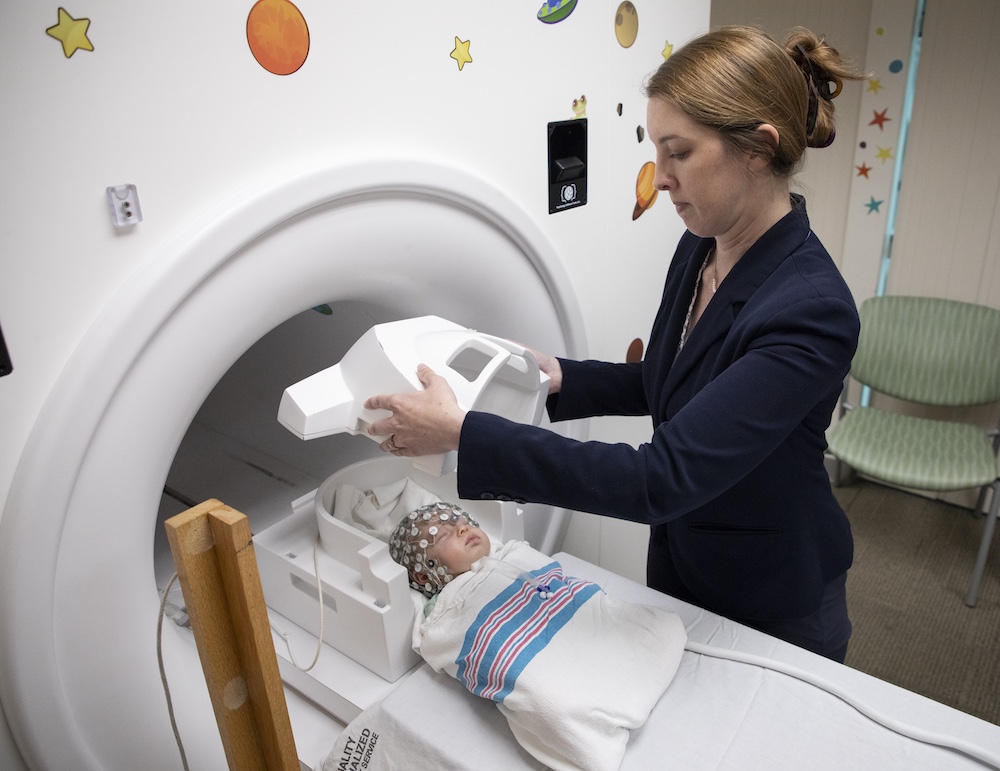
Muriah D. Wheelock, PhD, and Brian A. Gordon, PhD, were awarded a $5 million, five-year grant from the NIH National Institute on Aging to examine how early-life stress on the developing brain can influence brain aging and the progression of neurodegenerative diseases such as Alzheimer’s.
Adverse circumstances in the first years of life — such as low birth weight, poverty, unsafe living conditions and exposure to trauma — are known to alter the development of certain brain regions in ways that are visible on MRI scans and that persist well into early adulthood. These regions, which govern complex functions such as decision-making, language, emotional regulation and memory, are the same ones that take longer to develop than other brain regions and that tend to be affected by Alzheimer’s and other age-related neurodegenerative diseases. Researchers have dubbed this phenomenon “last in, first out,” meaning that the brain regions that develop last are the first to be affected by disease in old age.
Wheelock, an assistant professor at WashU Medicine Mallinckrodt Institute of Radiology (MIR), said that there was a longstanding theory in the neuroscience community that there was mirroring between neurological development and neurological degeneration. But the idea that the areas of the brain that mature last are the first to degrade had not been scientifically quantified, in part because of the computational complexities that the work would require. Furthermore, longitudinal studies of early-life adversity and health tend to follow participants only into young adulthood. This means that data connecting detrimental brain changes in infants and toddlers to neurodegeneration in old age are lacking.
To fill the gap, Wheelock and Gordon — an associate professor at MIR and co-principal investigator on the study — will analyze brain images and other data from large cohorts of individuals across the lifespan to understand how neurodevelopmental changes in the brain’s functional connectivity (the patterns in how different brain regions speak to one another to complete tasks) caused by earlylife adversity may prime the brain for specific patterns of degeneration later.
“Damage to these later developing regions could be on a lifelong trajectory that can show up later in life as Alzheimer’s disease or other conditions,” said Wheelock. “We might be able to identify early-childhood or even maternal interventions to reduce the risk of Alzheimer’s and other age-related neurological disorders.”
Over the next five years, their labs will analyze thousands of MRI scans, patient histories and biomarkers from large cohorts representing both ends of the human lifespan, drawn from databases collected at WashU Medicine and other institutions around the world. With that information, they aim to characterize the overlap between early-life development patterns and later-life degeneration, track how adverse social factors and genetic risk factors affect those patterns, and explore the underlying mechanisms of aging and disease progression.
One goal is to identify early-life interventions to mitigate the social stressors tied to neurodegeneration later in life and thereby minimize their influence on age-related diseases.
“The brain is much more plastic in that zero-to-two age range, so any intervention is magnified relative to any other point in life,” said Gordon. “It’s still speculative that we could prevent or reduce Alzheimer’s disease with environmental changes in childhood, but we’re hoping to at least start that discussion.”
Published in Focal Spot Spring/Summer 2026 Issue